We sometimes mention fascia in our Pilates lessons — perhaps when encouraging those little bouncing or pulsing movements to “hydrate the fascia”, or when we describe it simply as the connective tissue of the body.
But what actually is fascia? What does it do, how does it behave, and why is it important to us when we move?
Fascia is a relatively new area of research in anatomical terms. Compared with bones and muscles, which have been studied for centuries, our understanding of fascia is still developing. The first International Fascia Research Congress was held in 2007, and new research continues to expand our understanding of this fascinating part of the body.
In 2015, Carla Stecco described fascia as:
“A sheath, a sheet, or any other number of dissectable aggregations of connective tissue that forms beneath the skin to attach, enclose and separate muscles and the internal organs.”
This tells us what fascia is — connective tissue — but it doesn’t really tell us what it does, how it behaves, or why it matters.
A later definition from Schleip and colleagues, 2019, gives us a little more insight:
“The fascial system surrounds, interweaves, and interpenetrates all organs, muscles, bones, and nerve fibres, endowing the body with structure and providing an environment that enables all body systems to operate in an integrated manner.”
Now we start to get a sense of just how important fascia is. Rather than being a collection of separate bits of tissue, fascia helps connect and integrate the different parts of our body.
Perhaps an easier way to think about it is as the body’s “soft skeleton” (Vleeming, 2011).
But unlike our bones, which form separate structures connected by joints, the fascial network is one continuous structure throughout the body (Lesondak, 2017).
Imagine a soft, three-dimensional web running throughout you — wrapping around, between and through your muscles, organs, nerves and bones, connecting and supporting everything as you move.
Pretty important stuff!
There are different ways of classifying fascia. One simple approach is to think about four main groups:
Fascia therefore isn’t simply something that wraps around our muscles. It is a dynamic, interconnected system that helps with support, organisation and communication throughout the body.
Fascia helps to support and shape the body, allowing tissues to glide smoothly over one another as we move. It helps transmit forces through the body, contributing to efficient movement.
It also contains sensory nerve endings, which means it plays an important role in how we sense and respond to movement. In this way, fascia is part of the body’s communication system, helping us develop awareness of where we are and how we are moving.
There is much more we could explore here — there are some fascinating books and research studies, as well as dissections and imaging showing what fascia actually looks like inside the body.
But rather than getting too far into the anatomy, let’s bring it back to what fascia means to us in relation to movement and Pilates.
Like other tissues in the body, fascia can be affected by how we live and move and be in a healthy or unhealthy state.
We want our fascia to be healthy – flexible and hydrated fascia that can move and stretch well and is elastic so it maintains its form.
Unhealthy fascia is stressed, stiff, dry – it can restrict movement and cause discomfort.
Unsurprisingly, hydration is important. Fascia contains a lot of water, so drinking enough fluid is part of looking after our connective tissues.
Nutrition also matters. Our bodies need a range of nutrients to build and maintain connective tissue, while a balanced diet supports overall tissue health. It may also be helpful to limit foods that can contribute to inflammation when eaten excessively, such as highly processed foods and large amounts of added sugar.
But perhaps the most obvious thing we can do is simply…
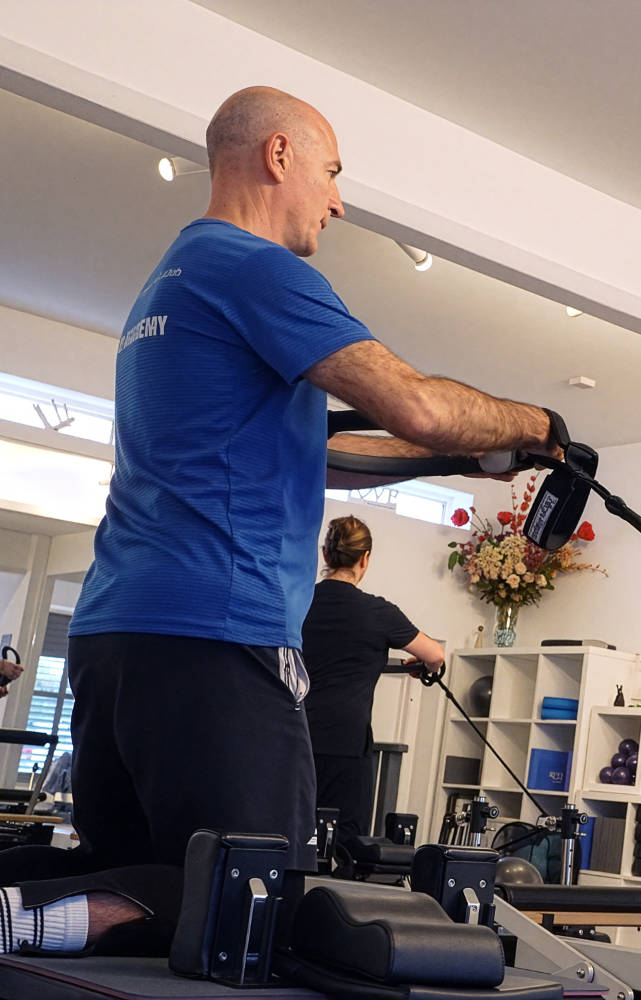
From a Pilates point of view we are looking at moving regularly striving to keep the fascia moving well in all directions.
This doesn’t necessarily mean doing something complicated. In fact, many of the things we already do in Pilates can support healthy fascial movement.
Bouncing movements can help develop spring like effortless action of the fascia – combating tissue stiffness, improving circulation and promoting hydration.
Other movements and breathing exercises can stimulate the nervous system and fascial receptors to improve body awareness and aid relaxation. Looking at how forces are transmitted across the body; using movements that stabilise one part of the body so you can easily move another, or engaging one part of the body to help engage another where they are linked through the fascial web.
Movements that hydrate the fascia – the theory being that simply pouring water on a dry sponge does not effectively hydrate it, you have to squeeze and massage the sponge so it will let the fluid in – things like foam rolling muscles can help hydrate the fascia, using the stability balls, encouraging some swinging, twisting spiralling, perhaps weighted, movements are all ways of using movement to move, compress and release fascia to help keep fluid moving through the tissues.
This might all sound like an awful lot to think about!
Fortunately, Pilates already incorporates many of these principles.
As David Lesondak concludes in Fascia: What It Is and Why It Matters:
“It is becoming more accepted that exercise that includes a fascial component is important for building better health and resiliency.”
He goes on to suggest that fitness which emphasises full-body movements, together with attention to how movement feels, makes both yoga and Pilates particularly well suited to this approach.
Looking at fascia reminds us that the body isn’t simply a collection of separate muscles and bones working independently. It is a connected, constantly communicating and adapting whole, working together to keep us moving efficiently. And perhaps the simplest way we can support this remarkable system is to keep our bodies moving.
By Kate Wilson