The Origin of Pilates

The story of Pilates begins with one remarkable, determined and rather unconventional man: Joseph Pilates.

Childhood 

Born in Germany in 1883, Joseph was a sickly child who suffered from asthma, rickets and rheumatic fever.  Rather than allowing poor health to define him, he became fascinated by the human body and set out to transform his own.  He explored boxing, gymnastics, yoga and other forms of physical training.  

His father was a gymnast, while his mother was a naturopath, a combination which surely influenced his determination to use exercise and movement to promote self-healing.

England

During the First World War, Joseph was living and working in England as a boxer, circus performer and self-defence trainer. When war broke out, he was interned at Lancaster Castle along with other German citizens.

Joseph turned this curtailment of freedom into an opportunity. He began teaching his fellow Germans his developing system of exercises, challenging them to become fitter and stronger despite their circumstances.

He was later moved to the Isle of Man, where he continued to refine his method of exercise.  The connection with the Isle of Man remains part of the Pilates story today. In a recent celebration of this history, almost 3,000 people gathered there in an attempt to stage the world’s largest Pilates class. Although they didn’t break the overall record, they did achieve a new record for the largest number of people performing a standing roll-down exercise. See the story on BBC News Website here.

The Method

Joseph originally called his method of exercise Contrology because the central concepts of his system were control of the mind over the body, and the control of the breath over movement, with a particular focus on core muscles (also referred to as the powerhouse of the body), postural muscles and spine alignment.  Breath, concentration, precision and control were fundamental to his approach.

For Joseph, exercise wasn’t simply about making muscles stronger.  It was about teaching the body to move better as a whole.

The Inventions

Joseph’s creativity didn’t stop with the exercises themselves.  He was also a prolific inventor.  During the war he used bedsprings to provide resistance to work different muscle groups to help rehabilitate injured soldiers.  This was the start of his creation of many different pieces of Pilates apparatus.

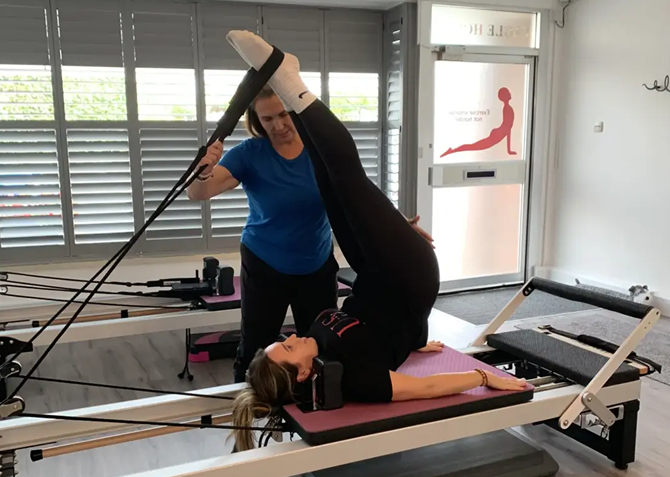
The Reformer, Cadillac, Chair, Foot Corrector and Ladder Barrel, among others, were designed as tools to help people understand and perform movement.

The apparatus could assist someone in achieving a movement they couldn’t yet perform independently.  Or, it could provide resistance, challenge balance or destabilise the body to make an exercise more demanding.

Ultimately, the goal was to be able to perform the movements without assistance, using the body itself as the primary tool.


America

After the war, Joseph emigrated to America, meeting his wife, Clara, during the transatlantic crossing.

In 1926, the couple opened their studio at 939 Eighth Avenue in New York City.  Their home was above the studio, and the space was filled with Joseph’s ingenious equipment and inventions.

There were several dance studios nearby, and it wasn’t long before dancers began discovering the studio – discovering that Joseph’s method was an effective way to recover from injuries, but also that it was a great way to strengthen the body and prevent further injury, improve core strength and to power athletic movement.

Legacy

Joseph’s philosophy extended far beyond a series of exercises.

He believed that good health depended upon a harmonious relationship between the mind and body, and that natural, intelligent movement could help prevent illness and improve quality of life.

He wrote two books. Your Health explored his philosophy of Contrology, including his ideas about health, movement and the mind-body connection.  He later co-wrote Return to Life Through Contrology, which detailed the sequence of 34 original floor work exercises.

Interestingly, while these exercises were recorded and published, Joseph’s equipment-based system was never officially documented in the same way.

This meant that much of the method was passed from teacher to teacher — through observation, practice and experience.

Joseph and Clara continued teaching at their New York studio into the 1960s. Joseph died in 1967, aged 83, after suffering from advanced emphysema, which was undoubtedly worsened by a studio fire in 1966 when he had been trapped in the building while trying to save his belongings.

Clara continued teaching after Joseph’s death.  The teachers who had trained directly with Joseph and Clara became known as the Pilates Elders. They preserved and passed on what they had learned, teaching subsequent generations and keeping Joseph’s original method alive.

And so Contrology evolved into what we now simply call Pilates.

Joseph Pilates was undoubtedly a man ahead of his time.  He saw exercise not simply as a way to change how the body looked, but took a holistic approach which combined strength, flexibility, breathing, concentration, posture, precision and control.

He was also, by all accounts, quite a character.  He had strong opinions and an unwavering belief in his method.  He demanded precision, advocated cleanliness and was regularly seen in his, now infamous, workout briefs.

More than a century later, millions of people around the world continue to practice and enjoy and be inspired by Pilates.  What began with one man’s determination to overcome his own physical limitations has become a global movement practice — helping people build strength, improve mobility, develop body awareness and reconnect the mind and body.

by Kate Wilson 

Click here to book a Pilates class
  • “The Most Fantastic Set-Up”

    The Pilates Boutique has the most fantastic set-up for its users. With a maximum of seven reformers, you are guaranteed almost 121 support from Lisa when you exercise. She really takes the time to explain exactly what we should be feeling and what our bodies should be doing to ensure we are doing the exercises right. She has eyes everywhere to make sure we are getting the best from our sessions and is always on hand to tweak and individualise each of us, so we gain maximum benefit from the time we spend with her. Thank you, Lisa!

  • Find Your Session

    Find a session that fits your week and book your place online in just a few clicks. Explore the timetable, choose your level, and enjoy clear coaching in a boutique studio setting.

    Find Out More